


figure in my work

People sometimes ask whether figurative work still has anything left to say. The usual answer is that the figure has become a vehicle — for commentary on identity and inequality, for emotional expression, for formal experiment. All of that is true, and all of it is too general to be much use. What I can tell you is what the figure does in my own pieces, which is narrower and stranger.
It gives me a structure to argue with.
In Personality Lor, the body is cut into flat planes — grey, scarlet, a wedge of cream — and the red crosses her torso as a plane, not as skin. Nothing is modeled. There is no light falling on a form, only shapes deciding where the form will be. Above her the background breaks into a storm of scratched red and grey; below, into a lattice of diamonds. She is held between two kinds of disorder, and the steadiest thing in the picture is the thin drawn line that finds her hand.

In the paper fold makes the method explicit. The figure is drawn in red contour alone on a green ground — no fill, no weight, just the line. Then a darker band crosses the picture, and where the body enters that band it turns solid red. The same figure exists in two states in one image, and what decides between them is not anatomy. It's a fold in the background. The background isn't behind her. It is making decisions about her.
That is the part I find endlessly interesting. We are taught that a background supports a figure. In practice it competes with one, crosses it, interrupts it, and sometimes hands it its substance. Most of my working time goes into that negotiation.
Then there are the faces, which is to say there aren't any. In Male Figure, Mike the body is a single red silhouette, knees drawn up, arms wrapped around the legs, head turned down into itself.
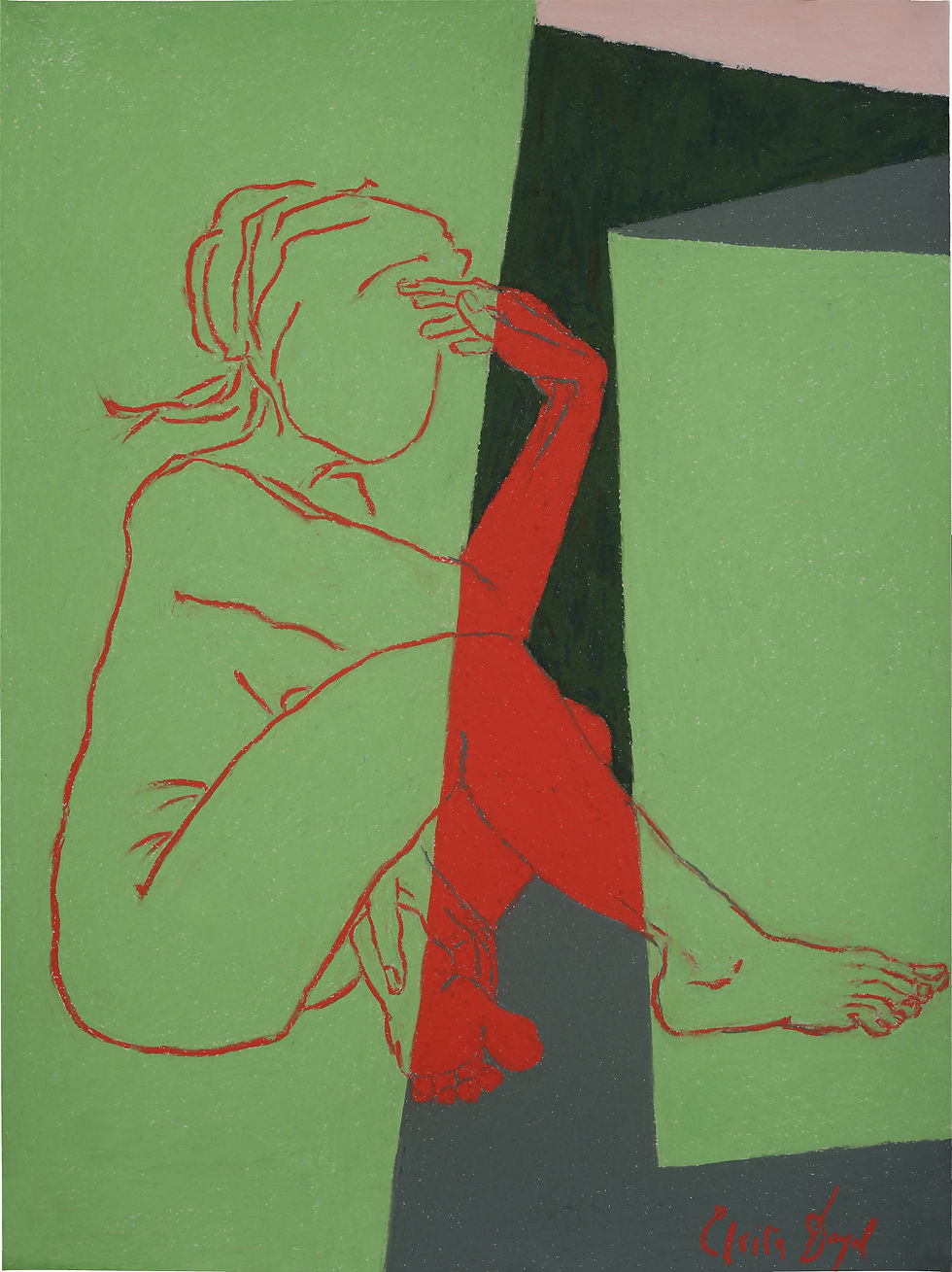
In Male Figure, Seated & Looking Away, the title says it outright. Across all four of these pieces the face is bowed, hidden, averted, or covered by a hand.
Two of them carry names. Lor. Mike. A name promises a particular person, and then the picture declines to hand over a likeness. I don't think of that as withholding. A posture tells you more than a face does, and it tells you something harder to argue with — how someone sits when they believe no one is watching, what they do with their hands, whether they fold inward or open out.

So when I'm asked what the figure is for in contemporary work, my honest answer is that it remains the best structure I know for making decisions visible. It has a shape everyone already recognizes, which means every departure from it registers. Flatten it and you can see the flattening. Split it between line and plane and you can see exactly where the split falls.


Comments