


Bucha 2022, Ukraine. Mass Graves & Black Plastic

Bucha, in the Kyiv region, was occupied by the russian forces from late February 2022 until their retreat at the end of March. What followed the retreat is this work's subject: the searching of the ground, the opening of the mass graves, and the lifting out of the dead.
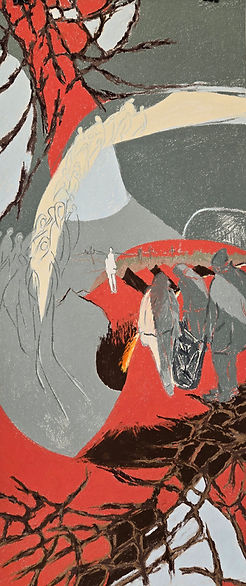
The sheet is narrow and very tall, and it is meant to be read upward. It begins in soil and ends in sky, and the movement between those two facts is the work.
The bottom of the picture is earth and thicket. Brick red floods the lower field — not a symbolic red but a ground red, the color of turned clay — and across it spreads a dense network of dark brown branching line, drawn fast and left raw. These are the bare trees of a northern suburb in early April, and they are also wire. The artist does not separate the two, and in Bucha they were not separate. The same tangle closes the top of the sheet, and caught in its gaps are small shards of pale blue — the sky broken into pieces by the branches that hold it. What the thickets do structurally is seal the picture: one open band across the middle, and no way out of it at either end.
Sweeping through that band is a broad arc of pale cream and light blue, rising from the lower left and curving up beyond the frame — the one place in the work where the sky comes down and touches the ground, and the only movement that goes anywhere. Along its length the artist has drawn a procession of thin outlined figures, upright, ranked one behind another, several with arms lifted. They are contour and nothing else — no mass, no shadow, no color — laid into the pale ground so lightly that they resolve when the viewer steps close and dissolve again at a distance. Light blue is the most fragile substance in the picture, surviving everywhere else only as fragments; here it gathers into something continuous, and it has been given to the dead. The decision to spend the picture's one passage of open sky on their ascent, and to withhold from them any physical body at all, is the whole argument compressed into a choice of color. What was taken from them is exactly what this restores: not life, but an open sky over people who were buried without one.
To the left a second crowd stands in the grey, drawn in the same weightless line, going nowhere. Between them, on the crest of a red rise, a single small figure is painted solid white — the most opaque mark on the sheet, the only one granted full pigment at that scale. It faces out, toward us. Behind it runs a dark strip broken by posts and thin horizontals, with small crossed marks along the ridge: a fence line, a perimeter, a row of graves. The ambiguity is not evasion; it is what such a ridge actually looked like.
To the right the drawing changes register entirely. Four figures stand massed together in solid grey and dull white, hooded and hunched under the weight of what they carry — a dark bundle slung low between them. Unlike the processional figures they have volume, gravity, bodies. They are the only people in the picture doing something, and what they are doing is carrying the dead.
Immediately below them a dark rounded form opens into a flare of orange and yellow — heat in cold earth, the single hot color in the work and the only passage laid down with real velocity. Around it, angular cuts sit low in the red, hard-edged where the rest of the picture is drawn or brushed: trenches, pits, the shape a grave makes once it is no longer hidden.
The red is left unresolved between earth, field and blood, and the grey-green above it gives no season and no hour. Everything is inside that opposition except two things — the seam of fire in the pit and the pale blue arc above the ridge. One is the moment of finding. The other is what finding is for.
The structure delivers the sequence as a verdict. The graves are open. The work of lifting is underway. The ascent has already begun.
to purchase this work press here
to see more about this work press here


Comments